Marie-Thérèse SOMBO AYANNE SAFI MUKUNA: A VISIONARY STATESWOMAN AT THE HEAD OF ESURS-I
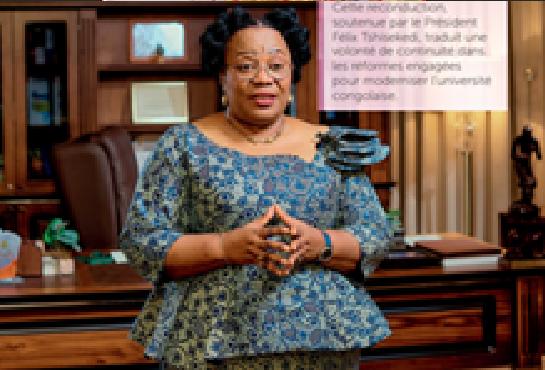
Her
scientific career is based on extensive clinical experience with patients, as
well as a constant commitment to training future healthcare professionals. As a
university lecturer, she teaches courses in neurology, psychiatry,
neurophysiology, and medical psychology at several higher education
institutions in the country.
A
scientific profile atstate service
A 2004 graduate in medicine from the University of
Kinshasa, Professor Marie-Thérèse Sombo Ayanne Safi Mukuna specialized in
neuropsychiatry, a discipline at the interface of neurology and psychiatry,
allowing for an integrated approach to brain and behavioral disorders. Her
scientific career is based on extensive clinical experience with patients, as
well as a constant commitment to training future healthcare professionals. As a
university lecturer, she teaches courses in neurology, psychiatry,
neurophysiology, and medical psychology at several higher education
institutions in the country. Through her teaching, she contributes to training
a new generation of doctors and researchers better prepared to manage
neurological pathologies and mental health disorders, which are still
underdiagnosed and undertreated in Central Africa.
Concurrently, she is an associate researcher at the
National Institute of Biomedical Research (INRB), where her work focuses on
neurodevelopment, epilepsy, neuro-infectious diseases, and mental health. Her
research is contextualized, attentive to the epidemiological and social
realities of the Democratic Republic of Congo. This dual expertise—scientific
and pedagogical—strengthens her legitimacy to lead a strategic ministry. She
understands the challenges of university governance, grasps the structural
challenges of research, and appreciates the importance of quality higher
education as a driver of national transformation.
Reformsstructuring
Since taking office, the minister has undertaken
several major actions:
System evaluation LMD in order to improve its quality and alignment
with international standards.
Reorganization of doctoral training,with stricter criteria to guarantee academic
excellence.
Deployment of distance learning (EAD),particularly in crisis zones.
Promoting digital educationthrough a national EAD platform and the "I am
Tech" campaign aimed at promoting digital inclusion.
Positioning universities as incubatorslocal solutions, notably during the international
symposium in Mbuji-Mayi.
Research
and innovation:a strategic tripod
Under the leadership of Professor Marie-Thérèse
Sombo Ayanne Safi Mukuna, the ministry has adopted the abbreviation ESURS-I
(Higher and University Education, Scientific Research and Innovation). This new
acronym reflects a structured and integrated vision of the sector, conceived as
a true three-pronged pillar of national development.
1. Higher and university education (public and
private)
This first pillar aims to strengthen academic
quality, institutional governance, and the alignment of training programs with
the country's socio-economic needs. It seeks to consolidate universities as
spaces for knowledge production, professional development for young people, and
the promotion of scientific ethics.
2. Scientific research, basic and applied
Research is considered a strategic lever for
producing knowledge adapted to Congolese realities. Whether conducted in
universities, public institutes or non-state structures, it must address
national challenges in areas such as health, agriculture, the environment,
social sciences or emerging technologies.
3. Technological and social innovation
This third pillar values Congolese ingenuity,
whether it comes from academia, the private sector, or the diaspora. Innovation
is not limited to digital technologies: it also encompasses industrial
processes, social solutions, local inventions, and know-how adapted to local
realities.
This focus is supported by the Congolese Scientific
Engineering Incubator, a true platform for the maturation and development of
innovative projects. Its mission is to support the transformation of research
results into competitive products, services, or processes capable of generating
economic value and strengthening the scientific and technological sovereignty
of the Democratic Republic of Congo. Through this strategic framework, ESURS-I
aims to make Congolese universities not only centers of knowledge, but also
drivers of development, industrialization, and sustainable social
transformation.
A visionof the future
Professor Marie-Thérèse
Sombo Ayanne Safi Mukuna embodies a governance focused on action, ethics, and
innovation. By emphasizing modernization, digitization, and the promotion of
research, she aims to make Congolese universities drivers of sustainable
development and scientific sovereignty.
Professor Marie-Thérèse Sombo Ayanne Safi Mukuna
embodies a governance focused on action, ethics and innovation.
A clear message emerges from
its renewal: higher education in the Democratic Republic of Congo is entering a
phase of structured transformation, where research and innovation become central
levers of national progress.
No comments for the moment