ECO-ZAMBA : HOW IS SNPC REINVENTING THE CONGOLESE EXTRACTIVE MODEL THROUGH ECOLOGICAL TRANSITION?
As the fight against climate change redefines global
economic priorities, the National Petroleum Company of Congo (SNPC) is evolving
its development model. Long associated with hydrocarbon exploitation, the
Congolese state-owned company is now investing in a new area: the green
economy. Through its ambitious Eco-Zamba afforestation project, developed in
the Ngo district, north of Brazzaville, SNPC intends to demonstrate that an oil
company can also become a player in ecosystem restoration, carbon
sequestration, and sustainable local development. More than just a
tree-planting operation, Eco-Zamba aims to embody a new vision of environmental
responsibility, reconciling economic performance, biodiversity protection, and
social inclusion.
FROM BLACK GOLD TO GREEN CARBON
AN INITIATIVE BORN OF A PRESIDENTIAL AMBITION
The project originated from
the call made by the President of the Republic, Denis Sassou N'Guesso, at
COP27, held in Sharm el-Sheikh, Egypt, in November 2022. The Head of State
advocated for the establishment of a Global Decade of Afforestation and
Reforestation to strengthen the role of forests in the fight against climate
change. In line with this, SNPC decided to make the ecological transition a
major pillar of its Corporate Social Responsibility (CSR) policy. The company
thus integrated Eco-Zamba into the National Afforestation and Reforestation
Program (PRONAR) and its objective of contributing to carbon neutrality by
2050.
CHANGE OF CULTURE AT WITHIN AN OIL COMPANY
For a company specializing
in hydrocarbons, investing heavily in afforestation represents a true paradigm
shift. SNPC's CEO, Raoul Ominga, acknowledges that the project wasn't
immediately met with unanimous approval. "When you step outside your core
business, the risks are significant. Initially, nearly 90% of my management
committee was skeptical," he confides. A visit to the forest site
developed by TotalEnergies in Batéké ultimately helped convince the teams of
the project's relevance. For Raoul Ominga, the stakes go far beyond
environmental communication. "SNPC is an extractive industry. We
inevitably contribute to greenhouse gas emissions. Eco-Zamba represents our
contribution to carbon offsetting and the preservation of our natural
heritage."
To ensure the scientific
credibility of the project, SNPC relied on the expertise of the Ministry of
Forest Economy as well as an international firm specializing in carbon
projects.
5,000 HECTARES TO CREATE A NATIONAL CARBON SINK
Two years after its launch,
Eco-Zamba has become one of the largest afforestation projects undertaken by a
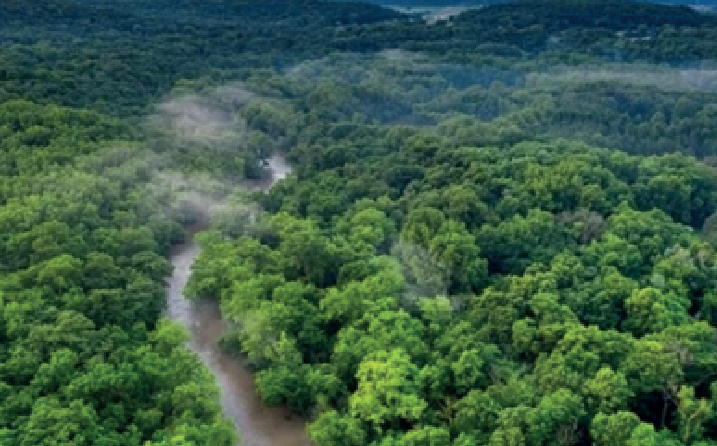
public company in Central Africa. On Ngo's land, 5,000 hectares are being
progressively transformed into forest areas capable of capturing several
hundred thousand tons of carbon dioxide over the coming decades. Beyond
planting trees, the project aims to restore degraded soils, improve
biodiversity, protect water resources, and create a vast natural carbon sink.
This initiative now
positions Congo among the African countries that are relying on nature-based
solutions to address climate challenges. "When we present Eco-Zamba at
major international summits, we are proud to show that Congo is taking concrete
action," emphasizes Raoul Ominga.
MAKING CARBON A ENGINE
OF DEVELOPMENT
One of Eco-Zamba's unique
features lies in its economic model. For SNPC, the value of future carbon
credits should not solely benefit the company. It must also generate income for
the communities living around the project. The program is therefore based on an
agroforestry system combining forest plantations and agricultural crops. Plots
of land are made available to families so they can develop income-generating
activities while contributing to the protection of the plantations.
“We want to create
micro-enterprises around the project. People must be able to earn a living
through this new green economy,” explains the Managing Director. This approach
not only helps combat rural poverty but also strengthens local ownership of the
project.
GIVE BACK ALL ITS VALUE OF THE LAND
For Raoul Ominga, Eco-Zamba
also carries a message for Congolese youth. In his view, agriculture, forestry,
and environmental professions are now sectors of the future capable of creating
sustainable jobs. “We must reconnect young people with the land. With one or
two hectares, properly managed, it is now possible to generate significant
income while protecting the environment,” he asserts. The goal is to foster a
new generation of rural entrepreneurs capable of combining economic performance
with sustainable development.
A CSR STRATEGY WITH A TURN TOWARDS TOWARDS CARBON NEUTRALITY
Eco-Zamba illustrates the
profound evolution of the Corporate Social Responsibility policy led by SNPC.
The company is now basing
its development on three major priorities: reducing its carbon footprint;
developing natural carbon sequestration sinks and supporting local communities
in income-generating projects.
This strategy responds to
Congo's international climate commitments while strengthening SNPC's contribution
to the Sustainable Development Goals.
A SHOWCASE OF THE GREEN CONGO
While several challenges
remain—plantation maintenance, carbon certification, securing funding, and
ensuring the long-term involvement of local communities—Eco-Zamba is already
emerging as one of the most emblematic environmental projects in the Congo.
SNPC plans to organize a site visit for media professionals soon to showcase
the results achieved on the ground. Beyond the figures, Eco-Zamba symbolizes a
profound shift in the vision of development: that of an oil company choosing to
make forestry a new strategic investment.
In a context where
international markets are placing increasing value on carbon, Ngo's project
could well become one of the African benchmarks in green economy, demonstrating
that it is possible to transform an extractive industry into an actor in the
ecological transition without giving up its economic purpose.
ENVIRONMENTAL AND SOCIAL IMPACT LONG-TERM BENEFITS
The Eco-Zamba afforestation
project aims to generate significant environmental, social, and economic
benefits, making this initiative a major lever for protecting the planet and
improving the well-being of local populations. By developing and preserving forests,
Eco-Zamba contributes to carbon sequestration, ecosystem restoration,
biodiversity preservation, and improved living conditions for local
communities.
The Republic of Congo plays
a leading role in the preservation of the Congo Basin forests. In this
capacity, the Ministry of Forestry Economy implements the forestry policy
defined by the Government, in accordance with international commitments
regarding the sustainable management of tropical forest ecosystems.
No comments for the moment