AFRICAN PIONEERS IN THE WORLD CUP: ZAIRE 1974
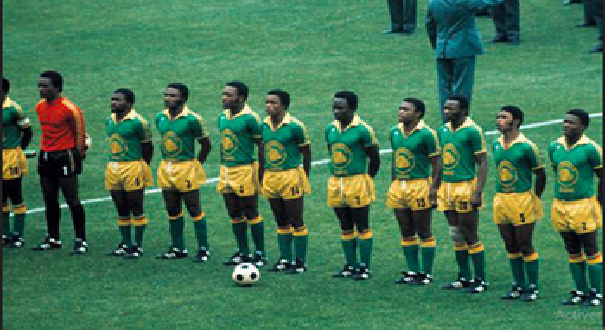
The Leopards of Zaire, now the Democratic Republic
of Congo, were the first sub-Saharan African team to participate in a FIFA
World Cup. In 1974, fresh from their continental title win and fueled by the
enthusiasm of their nation, the Zairians arrived in West Germany with the
ambition of making history. Their journey would be arduous on the pitch, but
this team would forever be enshrined in the legend of African football. Here is
their story.
By Pierre Desorgues on TV5 Monde
THE
LEOPARDS WHO PAVED THE WAY FOR AFRICAN FOOTBALL
GELSENKIRCHEN, THE EVENING OF THE
SHIPWRECK
On June 18, 1974, at the
Gelsenkirchen stadium, the Leopards of Zaire experienced one of the most
painful nights in their history. On the German pitch, substitute goalkeeper
Dimbi Tubilandu was once again forced to concede to Yugoslavia's onslaught.
Striker Branko Oblak scored one of the nine goals in a match that quickly
turned into a nightmare for the first sub-Saharan African team to participate
in a World Cup.
The final score of 9-0
remains to this day one of the heaviest defeats recorded in the history of the
world tournament. For the Leopards, this humiliation marked the end of an
adventure that had nevertheless generated immense hope throughout Africa.
Before this debacle, the Zairians had already fallen to Scotland (0-2), then to
Brazil, the reigning world champions (0-3).
Despite their courage and some flashes of quality play, the gap between them and the world's footballing elite was considerable, particularly in terms of physicality, tactics, and professionalism. On June 22, 1974, the Leopards were eliminated from West Germany in the first round, having suffered three defeats, conceded fourteen goals, and scored none. A humiliating exit from a sporting perspective, but one that shouldn't overshadow the essential point: Zaire had just opened a historic door for African football on the world stage.

▲ Zaire Leopards
player Mayanga Maku and Scottish player Billy Bremner fight for the ball in
Dortmund Stadium on June 11, 1974.
A DOMINANT GENERATION ON
THE AFRICAN CONTINENT
In the late 1960s and
early 1970s, Zaire established itself as one of the major powers in African
football. Led by a talented and ambitious generation, the Leopards became
ambassadors for a rapidly developing Congolese football scene. After their
first continental triumph in 1968, the Zairian national team confirmed their
status by winning a second Africa Cup of Nations (CAN) in 1974. Between these
two titles, the Leopards had already demonstrated their consistency at the
highest African level by finishing fourth in the 1972 CAN.
This dominance wasn't
limited to the national team. Congolese football also shone brightly at the
club level. AS Vita Club of Kinshasa won the African Cup of Champions Clubs in
1973, while TP Mazembe of Lubumbashi was already establishing itself as a
powerhouse of African football thanks to its experience and solidity. The
national team was then built on the core of these two giants of Zairian
football. Accustomed to major African competitions, the players possessed a
strong tactical understanding and genuine international experience.
Striker Kakoko Etepe, an
emblematic figure of this generation, would later sum up the confidence that
drove the Leopards before the World Cup: "We had a lot of experience in
international football, and our coach was also very experienced." At that
time, Zaire appeared as the standard-bearer of emerging African football,
capable of competing with the continent's best nations and harboring great
ambitions on the world stage.
BLAGOJE VIDINIC,
THE ARCHITECT OF THE EXPLOIT
At the helm of the
Leopards was Yugoslav coach Blagoje Vidinić, a former goalkeeper turned
manager. A few years earlier, he had already led Morocco to the 1970 World Cup
in Mexico, making the Atlas Lions the first African nation to participate in a
World Cup. Under his leadership, Zaire played a direct and attacking style of
football.
The qualifying rounds
resembled a true heroic campaign: elimination of Togo; victory against
Cameroon; success against Ghana; then a decisive confrontation against Morocco.
On December 9, 1973, the Leopards triumphed 3-0 in Kinshasa against the Atlas
Lions.
The second leg was
ultimately cancelled: Morocco withdrew. Zaire then became the first Black
African nation to qualify for a World Cup. A few months later, on March 14,
1974, the Leopards won another Africa Cup of Nations title, defeating Zambia
2-0 after a replay. Congolese football was then at the pinnacle of African
football.
A POPULAR FERVOR UNPRECEDENTED
Throughout Zaire, the
Leopards' qualification for the 1974 World Cup sparked a wave of enthusiasm
rarely seen in the country's history. From major cities to the most remote
villages, the population lived to the rhythm of the national team's exploits.
Radio broadcasts became moments of collective communion, while the players were
celebrated as true national heroes.
Historian Jean Omasombo Tshonda
has a vivid memory of this period of popular euphoria: “Everyone in my village
was glued to the radio. The authorities had asked each village to give gifts to
the players to encourage them.” In several regions of the country, residents
spontaneously participated in this surge of patriotism. Some villages offered
chickens, goats, or agricultural products to the players as a sign of support
and gratitude.
This popular mobilization
testifies to the deep attachment of the Congolese people to their national team
and to the already central place of football in Zairian society. The Leopards
became true national icons. Their portraits were printed on stamps, banknotes,
and official posters distributed throughout the country. Never before had a
sports team inspired such collective admiration in Zaire. Beyond the sport
itself, this epic journey gave an entire nation the feeling of having a
presence on the international stage and of writing a new chapter in African
history.

▲ Brazilian forward Jairzinho scores the first goal against the Zaire Leopards at Gelsenkirchen Stadium on June 22, 1974.
THE LEOPARDS, SHOWCASE OF THE
MOBUTU REGIME
President Mobutu Sese Seko
understood very early on the unifying power of football and its political
potential. In a vast country, marked by regional tensions and the aftereffects
of the post-independence period, the successes of the Leopards offered the
regime a unique opportunity to strengthen national sentiment and promote
Zaire's image abroad.
Since 1971, Mobutu pursued
a policy of "Zairian authenticity," intended to symbolically break
with the colonial legacy. The Congo was renamed Zaire, several cities changed
their names, and national institutions adopted new cultural references meant to
embody a rediscovered African identity. Football became one of the main
instruments of this policy. The national team, now called the Leopards of
Zaire, fully participated in this communication strategy.
Sporting victories are
presented as proof of the country's influence and the regime's success.
Each success of the
Leopards thus fueled official propaganda. The players were featured prominently
in state media, celebrated at public ceremonies, and transformed into symbols
of national pride. In the eyes of the regime, the historic qualification for
the 1974 World Cup was meant to demonstrate that Zaire had become a modern,
influential, and respected nation on the international stage. Football then
transcended the realm of sport: it became a tool of political, diplomatic, and
ideological prestige in service of Mobutu's regime.

THE SHOCK FROM ABOVE WORLD
LEVEL
When the Leopards of Zaire
arrived in West Germany in June 1974, the enthusiasm was immense. For many
players, this World Cup represented not only a historic adventure, but also a
unique opportunity to be noticed by major European clubs. At the time, few
African footballers were playing in the professional leagues of the European
continent.
Very quickly, however, the
Zairians discovered the vast gulf separating them from the major powers of
world football. Facing them were experienced national teams, composed of
professional players benefiting from far more advanced physical, tactical, and
medical preparation. In Zaire, the reality was quite different. The majority of
international players did not earn their living solely from football.
Many still have to work a
job or rely on side hustles to make ends meet. African football, therefore,
remains far from the professionalism that already characterizes the major
European and South American nations.
Despite these structural
limitations, the Leopards occasionally display genuine technical skill and an
attacking style of play. In their first match against Scotland, in particular,
the Congolese delivered a courageous performance that earned the respect of
many observers.
Striker Kakoko Etepe would
later lucidly summarize this reality:"We played with our hearts. But that
wasn't enough to compete at this level."This 1974 World Cup revealed both
the limitations of African football at the time and its immense potential.
Beyond the heavy defeats, the Leopards paved the way for generations of African
players who, decades later, would establish themselves in the world's biggest
clubs.
A RETURN IN THE BRUTAL LAND
After the Leopards'
elimination in the first round of the 1974 World Cup, their return home was
marked by a somber and somber atmosphere. Upon arriving in Kinshasa, the players
were met with a reception far removed from the euphoria that had accompanied
their departure for West Germany. No high-ranking official of the regime was
present at the airport to greet them. The heroes celebrated just weeks earlier
suddenly became symbols of a national failure. The government quickly sought
someone to blame for this sporting debacle, especially after the crushing 9-0
defeat against Yugoslavia. Coach Blagoje Vidinić became a prime target. His
Yugoslavian heritage fueled the criticism, with some close to the regime even
questioning his loyalty after the humiliating defeat against his country of
origin. Yet, just a few months earlier, Vidinić had led Zaire to one of the
greatest achievements in its history: a historic qualification for the World
Cup and a victory at the 1974 Africa Cup of Nations.
But in the political
climate of the time, the government refused to publicly acknowledge the
failure. The coach was quickly dismissed and then forced to leave the country.
At the same time, the entire propaganda machine built around the Leopards came
to an abrupt halt. The celebrations, official posters, and triumphalist
speeches vanished almost overnight. This rupture deeply affected several
players of that generation, who went from being national heroes to being
forgotten by the authorities in just a few weeks.

FROM THE WORLD CUP TO «
RUMBLE IN THE JUNGLE »
After the Leopards'
failure at the 1974 World Cup, President Mobutu Sese Seko quickly sought a new
event to restore Zaire's image on the international stage. His attention turned
to another spectacular and media-driven sport: boxing. On October 30, 1974,
Kinshasa became the center of the sporting world by hosting the legendary fight
between Muhammad Ali and George Foreman. The event, organized by the famous
promoter Don King, was dubbed "Rumble in the Jungle." At the time,
George Foreman appeared to be an invincible champion. Powerful and feared, he
dominated the heavyweight division. Facing him, Muhammad Ali attempted to
reclaim a world title he had lost several years earlier. The fight attracted
journalists, artists, and cameras from all over the world, offering the Zairian
regime exceptional international exposure. In the Kinshasa night, Muhammad Ali
achieved one of the greatest feats in the history of boxing. Thanks to his
famous rope-adope tactic, he exhausted Foreman before knocking him out in the
eighth round. This historic victory restored Ali's world title and transformed
the fight into a legendary event in world sport. For several months, the
sensation of the "Rumble in the Jungle" overshadowed the Leopards'
setbacks in Germany. Zaire once again became, for one historic night, the
center of global attention.
A TEAM ENTERED IN HISTORY
Despite their defeats, the
Leopards of Zaire remain pioneers. They paved the way for subsequent African
generations and demonstrated that a sub-Saharan African nation could reach the
world stage. Even today, their green and yellow jersey remains a powerful
symbol for Congolese fans. For Jean Omasombo Tshonda, this team also
represented an ideal of national unity: “The players came from Katanga,
Kinshasa, Goma, and Lubumbashi. This team projected the image of a united
Congo, beyond divisions.” As the Leopards dream of returning to the 2026 World
Cup, the epic 1974 campaign remains an essential reference point: that of a
courageous generation which, despite defeats, inscribed Congolese and African
football in the history of the World Cup.
No comments for the moment